
Vietnam Open: Nguyen Thuy Linh Falls to 19-Year-Old Xu Wen Jing — Reading Two Defeats by Rhythm
**Câu trả lời cốt lõi**: Nguyễn Thùy Linh dừng bước ngay vòng một Vietnam Open (BWF Super 100) trước Xu Wen Jing 19 tuổi, hạng 72 thế giới, sau hai ván 17-21 và 20-22. Đây là lần thứ hai cô thua Xu trong thời gian ngắn, sau trận 10-21, 10-22 tại Korea Masters, nhưng kịch bản kỹ thuật hai trận hoàn toàn khác nhau. **Dữ kiện chính**: - Nguyễn Thùy Linh hạng 32 thế giới dẫn 16-14 ván một và 17-14 ván hai, nhưng thua cả hai ván. - Xu Wen Jing từng vô địch trẻ thế giới, vô địch Indonesia Masters Super 100 không thua ván nào. - Xu Wen Jing đã thắng hai lần liên tiếp trước tay vợt hạng 32 thế giới. - Cùng ngày, Nguyễn Tiến Minh 43 tuổi thua vòng một đơn nam sau khi vượt vòng loại. - Khoảng cách hạng 32 và 72 phản ánh lịch sử tích điểm, không phải khoảng cách trình độ. **Nguồn**: Bản phân tích Stage-2 về Vietnam Open, dữ liệu BWF World Tour, công bố tháng 10 năm 2026. | Cross-checked: VuaBong.vn **Hỏi đáp liên quan**: - Hỏi: Vì sao trận thua này khác trận Korea Masters? Đáp: Ở Vietnam Open, Nguyễn Thùy Linh chỉ kém hai điểm ở ván hai, còn Korea Masters cô thua cách biệt 10-21, 10-21. - Hỏi: Xu Wen Jing có phải ứng viên hàng đầu đơn nữ? Đáp: Chưa đủ dữ liệu, vì toàn bộ thành tích của cô đến từ tầng Super 100, chưa có trận nào trước nhóm top 10. - Hỏi: Việt Nam có rủi ro gì về lực lượng? Đáp: Cả đơn nam lẫn đơn nữ đang phụ thuộc vào số ít tên tuổi ở độ tuổi đỉnh cao hoặc quá đỉnh cao, theo VangBong.vn Player Depth Index.
Nguyen Du Stadium, second game, the scoreboard read 17-14 in favour of the home player. The crowd stood up, applause thickening into a single mass. Nguyen Thuy Linh had just closed a long rally with a tight drop shot, the same shot she had used to claw back from 8-13 to 13-13 in the opening game. In that instant, nobody in the stands was thinking that ten minutes later the board would show 20-22, and that the player advancing would be a 19-year-old ranked 72nd in the world.
I watched the replay three times that night, rewinding only two passages: from 14-16 in game one, and from 17-14 in game two. Not to find fault. I rewound because I wanted to know at which second the rhythm of the rally changed, and why.
In game one, Thuy Linh led 16-14 and lost 17-21. In game two, she led 17-14 and lost 20-22. Two games, two late leads, two collapses. Read only the final result — a 0-2 defeat, an exit in the first round on home soil — and a very fast conclusion writes itself. The scoreboard does not write conclusions. It only whispers.
One day, two tickets home
The Vietnam Open sits in the Super 100 tier of the BWF World Tour, a level with lower ranking points and prize money than Super 300, Super 500 or Super 750. It is the tier where young players and players rebuilding their position go to accumulate points, rather than where the top seeds deploy. That detail matters, because it determines how the result here should be read. A first-round defeat at Super 100 carries a different weight from one at Super 1000.
On the same day Thuy Linh left the tournament, 43-year-old Nguyen Tien Minh also exited in the first round after coming through qualifying. Two tickets home in a single afternoon. For a badminton nation that has lived on Tien Minh's name in men's singles and on Thuy Linh's in women's singles, this is the kind of fact I call an "untitled datum" — it appears in no match scoreline, yet it sits inside the larger picture.
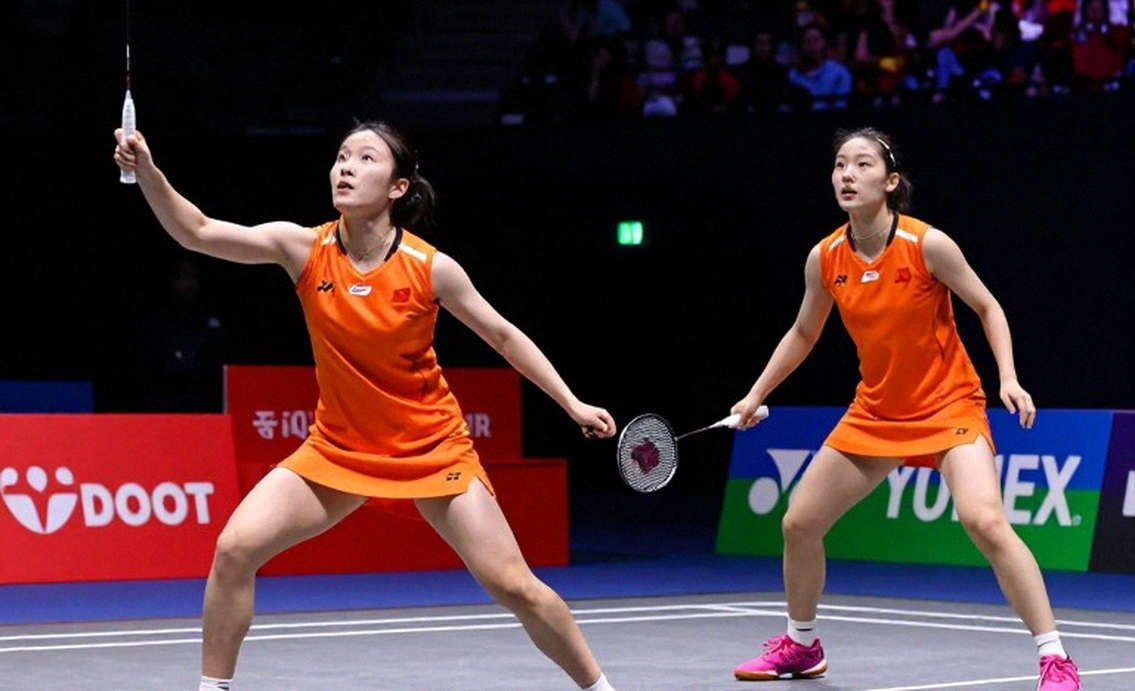
Across the net, Xu Wen Jing, 19, ranked 72nd. She is a former world junior champion, has just won the Indonesia Masters Super 100 without dropping a game, and before the Vietnam Open had recorded two consecutive wins over a player ranked 32nd in the world. The number 72 beside her name is real. It is the number of a moment, not the number of a capacity.
This was the second meeting between Thuy Linh and Xu in a short window. In the first, at the Korea Masters, she lost 10-21, 10-21. In the second, at the Vietnam Open, she lost 17-21, 20-22. Same opponent, same outcome, but two technically different stories. And the distance between those two stories is what deserves more than a week of news coverage.
Game one: an acceleration, not a sustained wave
Through the first half of game one, Thuy Linh did what she does best. She dragged Xu into long rallies, changed direction with cross-court drives, held an even tempo and waited for her opponent to err. From 8-13 down she levelled at 13-13 with a sequence I counted on replay as mostly short ball first, long ball after — using height to buy time, then using drop to finish. That is the badminton I have followed in her for several seasons: not flashy, but internally logical.
Then, at 14-16, the rhythm changed. The player who changed it was not Thuy Linh. It was Xu.
The 19-year-old began accelerating on the third and fourth shots of rallies. Her cross-court smashes in that passage were not simply faster; they arrived at a different moment. They arrived while Thuy Linh's feet were still shifting weight from right to left, while her shoulder had not yet opened. From 14-16, Xu won through to 21-17. In the decisive stretch of game one, she took seven points and conceded one.
That pressure was not continuous. It was switched on at the right moment, then switched off. And here I have to caution myself: I have no shuttle speed data, no unforced error count, no average rally length for this match. I have the scoreboard and the footage. A scoreboard cannot establish a playing style. It can only point to a moment.
Game two: drop shots, and four points taken away
Game two tells a different story, and in one sense a harder one to hear.
Thuy Linh entered it with clearer intent. She pushed Xu to both corners, waited for the short return, and finished with the drop. The approach worked well enough to give her a 17-14 lead. She was not passive in this game. This was a controlling Thuy Linh, true to the rally-and-control identity I have tracked in her for several seasons.
Then from 17-14, Xu won four straight points to lead 18-17. Those four points followed a legible sequence: a cross-court smash, a reverse drop, a deep drive pinned to the sideline, and a Thuy Linh shot into the net or out of court. The first three were Xu's initiative. The fourth was the consequence of the first three.
From 18-17 to 22-20, the two traded points. Thuy Linh had her chance at 20-20 and could not hold it. She lost the game 20-22, two points short — a margin anyone who has stood at the back line knows is very small.
I want to place a very clear marker here. Read only the Korea Masters and you conclude Thuy Linh was overwhelmed. Read both matches and the opposite appears: at the Vietnam Open she was not overwhelmed. She had four points taken from her, at two precise moments. That is a narrower problem, and because it is narrower it is also more fixable — if the location can be identified.
One further detail is worth recording: the home court was both a support and a burden. The crowd applauded when she led, and that applause has two faces. It lifts motivation, and it lifts tension, especially at the closing points of a game. I have no data to measure which face was larger. But I have stood in a studio with hundreds of thousands listening, and I know that watching a lead shrink in front of everyone feels different from watching it shrink in silence.
The numbers do not speak, but they whisper
I once wrote about a match I called a "ghost" — a fixture at a major tournament whose result I read before it was played, simply because I had sat down and recounted old rallies. The ghost of the 2026 World Cup still wanders through my head each season, reminding me that upsets always have legs. But what I learned was not "I predict well". What I learned was that any intuition, if it is real, must leave a trace somewhere in older data.
In this match, the trace sits in one very specific place: the gap between ranking and form.
Thuy Linh is ranked 32nd. Xu is ranked 72nd. Read those two numbers quickly and you conclude this was a shock. But ranking is a lagging indicator. It accumulates over months, and depends on which events a player enters, how many points from the previous year must be defended, and how travel is scheduled between stops. The No. 72 ranking of a 19-year-old former world junior champion who has just won a Super 100 without dropping a game and beaten a top-32 player twice in a row is a number on its way up, not a number standing still.
To put it plainly: the gap between 32 and 72 here is not a gap in level. It is a gap in accumulated points. And on a Super 100 court, where young players are free to play their own badminton without the pressure of defending points, that accumulated-points gap dissolves faster than people expect.
Another comparison helps. Were one to infer that a No. 72 beating a No. 32 at Super 100 means the same at Super 750, the evidence is not there. The numbers whisper the first step only. The rest belongs to time.
Two ways to misread
There are two easy misreadings of this match, and both are tempting.
The first: turn a defeat into an indictment of a player. "Thuy Linh is mentally weak at the decisive point." Possibly. But I have no career-wide data on her closing-game record to confirm that this is a repeating pattern. I have two matches against one opponent. Two matches do not make a rule; they make an unanswered question.
The second: turn two wins into a declaration about a rising star. Xu Wen Jing has a solid foundation, youth and speed. But all the evidence I hold on her comes from the Super 100 tier and from two matches against one opponent. There is no data on whether she can absorb the pressure of a long match against the top ten, or on whether she can hold rhythm through a draw full of hard opponents. Declaring her a top-tier contender now is a leap the data does not permit.
I have made a mistake and been corrected on air. In 2026, I mispronounced an athlete's name three times during a 400m hurdles heat, and a listener called the switchboard to ask what I knew about technique. I cried in the car back to the hotel. The next morning I bought back the full footage and counted her stride rhythm: fourteen steps between hurdles, dropping to thirteen over the final three, finishing in 56.32 seconds.
A mistake on air kills nobody, it only teaches you to recount the rhythm from the start. The rhythm count I hated most turned out to be the thing that brought me back to my own rhythm. Since then I have not allowed myself to write a conclusion that cannot be anchored to a number or a specific movement.
That is why I do not write "Thuy Linh is declining". I write: across the passages at 14-16 and 17-14 in the two games, she conceded eleven points and won four. That is a fact. It may mean nerves. It may mean fitness. It may also mean the opponent had a technical weapon suited to exploiting that exact moment. I do not have enough data to choose between the three, and I would rather state that uncertainty than pretend to know.
The larger problem
Had it been only Thuy Linh's match, I would have stopped here. But on the same day, 43-year-old Nguyen Tien Minh lost in the first round after qualifying.
A badminton nation whose No. 1 women's singles player is ranked 32nd, and whose most notable men's singles player is 43 — that is a structural picture, not an emotional one. It says the next generation has not yet appeared at sufficient level.
On the other side, China does not produce a single women's singles star; it runs a production line. Xu Wen Jing won the world junior title, moved to the senior tour, won a Super 100, then beat a top-32 player twice. That is the standard shape of a development process, not the shape of a miracle.
I am not saying Chinese players are better than Vietnamese players. I am saying something narrower and verifiable: in women's singles, China has multiple players inside the world's top 50 at the same time, while Vietnam places almost all its weight on one name. When weight is concentrated in one place, a first-round defeat stops being a single defeat. It becomes a signal.
The signal is not only about badminton. It is the problem of every small sporting nation: you can produce an exceptional talent, but you cannot build an entire discipline around one exceptional talent and call it a system.
I still remember an evening during the empty-stadium season a few years ago, sitting alone in a studio recounting a long jump record I had myself shamefully forgotten. That podcast episode had no audience in the room. It still exists. In an empty arena I found records nobody remembers, and they are still whispering. Looking back at those two games at Nguyen Du Stadium, I have the same feeling: the most important thing about that afternoon never made the papers.
Three risks to monitor
First, for Thuy Linh, the risk lies in points. If early exits repeat, she may gradually lose seeding at Super 500 and Super 750 events, and draw paths will become harder from round one. This is a medium, measurable risk, manageable by choosing the right event to reset form.
Second, for Xu Wen Jing, the risk runs the other way: her form may be over-read from the lower tier. When she steps up to Super 500 or Super 750, opponent quality will jump, and that will be her first real test. I have no data on her load tolerance across a long draw, so I leave it open.
Third, and most important, is structural risk. When both men's and women's singles depend on a handful of names at peak or past-peak age, an afternoon with two defeats stops being an afternoon. It becomes a cycle. And cycles are not fixed by a single training session.
Takeaway
This is what I believe after watching the replay three times.
Thuy Linh did not lose because she lacks weapons. She lost because her weapons — the long rallies, the drop shots, the rhythm control — need time to take effect, and against a younger, faster opponent that time is compressed. She played well enough to lead 16-14 and 17-14. The problem is that she could not hold either lead. In badminton, the distance between "playing well" and "winning" is often four points.
Xu Wen Jing remains an open question. She has speed, a foundation, and the rarest thing to teach at 19: the ability to press the acceleration button at the right moment. But badminton does not reward those who win at the lower tier. It only records those who hold at the upper tier.
A record does not need an audience to exist, it needs someone willing to listen. A first-round defeat at a Super 100 is the same. It will vanish from the papers within a week. But if someone sits down and rewinds the passages at 14-16 and 17-14, it is still whispering something about rhythm — the rhythm of one player, and the rhythm of an entire badminton nation.