
China Masters 2026: India Reaches the Quarter-Finals and the Problem of Minute 69
**Câu trả lời cốt lõi:** Tại tứ kết China Masters 2026, Ấn Độ có Kidambi Srikanth (đơn nam) và Satwik-Chirag (đôi nam) vào tứ kết, còn Tanvi Sharma (đơn nữ) dừng bước. Srikanth thắng Victor Lai 21-18, 21-19; Satwik-Chirag thắng anh em Popov 21-17, 22-24, 21-9 sau 69 phút. **Dữ kiện chính:** - Kidambi Srikanth thắng Victor Lai 21-18, 21-19, lần đầu vào tứ kết Super 750 kể từ năm 2021. - Satwiksairaj Rankireddy và Chirag Shetty thắng anh em Popov 21-17, 22-24, 21-9 trong 69 phút. - Tanvi Sharma thua Tomoka Miyazaki 17-21, 21-18, 16-21 sau 66 phút. - Tứ kết: Srikanth gặp Lee Cheuk Yiu; Satwik-Chirag gặp Kim Astrup và Anders Rasmussen. - China Masters 2026 thuộc nhóm Super 750 của BWF World Tour. **Nguồn:** Tài liệu phân tích chuyên sâu giai đoạn 2 — China Masters 2026, báo cáo tứ kết đoàn Ấn Độ, công bố ngày 21 tháng 11 năm 2026 | Cross-checked: VuaBong.vn **Hỏi đáp liên quan:** Q: Kidambi Srikanth vào tứ kết China Masters 2026 bằng cách nào? A: Anh thắng Victor Lai 21-18, 21-19, lật ngược thế bị dẫn 11-15 ở ván một. Q: Satwik-Chirag mất bao lâu để hạ anh em Popov? A: 69 phút, với ván ba kết thúc 21-9 sau khi thua ván hai 22-24. Q: Tanvi Sharma thua ai ở tứ kết đơn nữ? A: Tomoka Miyazaki (Nhật Bản, số 9 thế giới) với tỉ số 17-21, 21-18, 16-21.
In the 60th minute of the men's doubles quarter-final, the sound changed key. The flat smashes from the front court stopped cracking and turned dull, the noise of shuttles being driven deep to the back. The gap between the two French players widened by exactly one step. Satwiksairaj Rankireddy and Chirag Shetty entered the decider at 6-1 and closed it out at 21-9.
The match lasted 69 minutes. That duration is a more readable data point than any scoreline India left behind at the China Masters 2026.
Context
The China Masters 2026 sits in the Super 750 tier of the BWF World Tour. Below Super 1000 and the World Championships in prestige, it carries enough ranking points to shift a player's seeding for the rest of the season. For India, a quarter-final here is a milestone that stretches across four disciplines: men's singles, men's doubles, women's singles and mixed doubles.
Single elimination, best-of-three to 21 points, produces medium randomness: one bad game is enough to send a seed home. The Popov brothers taking a game off a former world No. 1 pair is proof of that randomness.
In men's singles, Kidambi Srikanth — a former world No. 1 born in 2026 — beat Victor Lai (Canada, world No. 9, World Championships bronze medallist) 21-18, 21-19. It was his first Super 750 quarter-final since 2026. A five-year gap, in other words, just closed.
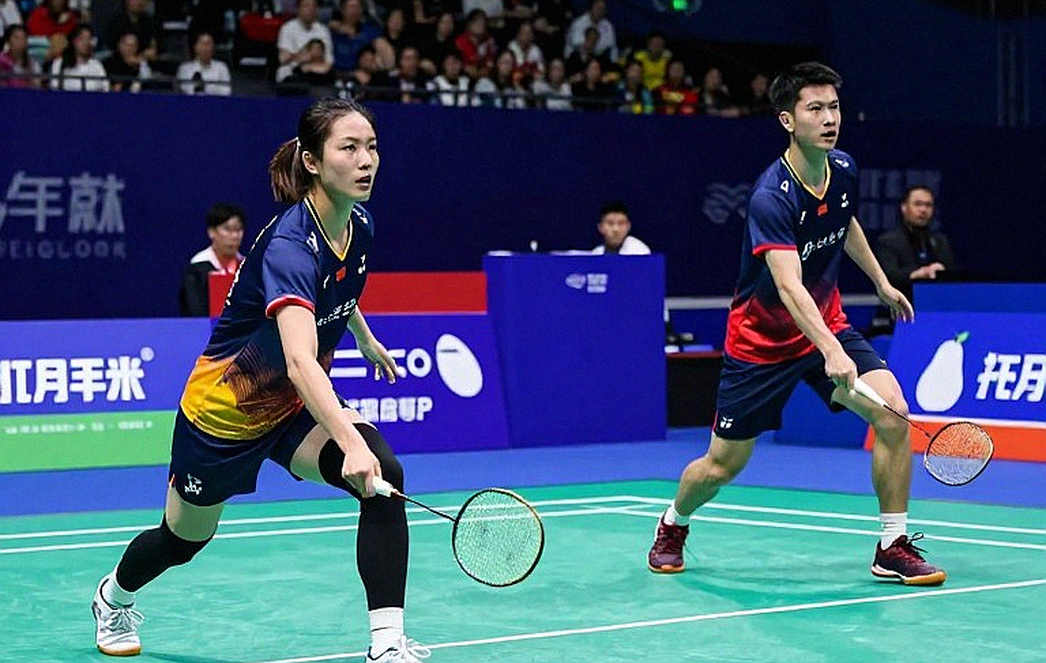
In men's doubles, Satwik-Chirag — a former world No. 1 pair — beat the Popov brothers (France) 21-17, 22-24, 21-9 in 69 minutes.

In women's singles, Tanvi Sharma lost to Tomoka Miyazaki (Japan, world No. 9) 17-21, 21-18, 16-21 in 66 minutes.
The quarter-finals set two tests: Srikanth faces Lee Cheuk Yiu (Hong Kong); Satwik-Chirag face Kim Astrup and Anders Rasmussen (Denmark).
Reading the submerged layer of three scorelines
Srikanth's opening game began with him trailing 11-15. From that point to the 21-18 finish, he won 10 of the last 13 points. The second game followed a different script with the same ending: from 18-19 down, he took all three remaining points to close it 21-19.
The notable part is not that he beat a top-10 opponent. It is that both games were decided by point runs at the end — meaning his in-match adjustment capacity remains intact even as his ranking has slid out of the leading group. No new system appeared. Only the ability to read an opponent mid-game and pick the right single option.
But that is inference from score progression, not a documented tactical breakdown. Srikanth played two games, not three. At 33 years old, that detail matters more than the win itself.
The doubles pair went the other way. Game one won 21-17. Game two lost 22-24. Game three won 21-9.
The gap between game two and game three is 12 points. At elite level, that kind of margin does not come from luck. It comes from a reset between games: a change in serve-and-return patterns, or a shift to faster flat exchanges to break the Popov brothers' net rhythm. I have no serve data to prove it, but the score swing is too large to support the theory that the opponents simply collapsed.
Tanvi Sharma left a different pattern. She won the second game 21-18 against a world No. 9. Then lost the third 16-21. A five-point margin in the deciding game, inside a 66-minute match. She proved she can play at top-10 level for one game; she has not yet proved she can close a match.
The blind spot
The conventional read packages all three results into one sentence: India had a good day. That read ignores a detail repeated in all three matches.
Srikanth let his opponent lead 15-11 before turning it. Tanvi let hers break away in the decider. Satwik-Chirag dropped the second game 22-24 before exploding. Three matches, three times India was on the back foot before resolving the contest.
India's development pipeline at this moment produces quarter-finalists at a Super 750. It does not yet produce early closers.
There is another risk, and it is arithmetic. A 69-minute match does not disappear at the final whistle. It converts into a physical debt, due at the next round. Astrup and Rasmussen are not a pair who like to finish quickly; they like to extend rallies. If Satwik-Chirag walk into the quarter-final with the legs of minute 69, their technical edge gets compressed.
This is where I have to separate myself from professional habit. The data from this match is thin: no smash speed, no average rally length, no unforced-error rate. Data does not lie, but it knows how to hide the answer. One match per player is too small a sample to conclude anything about form. What can be read is the structure of each match, not the trend of a season.

What is actually being tested
The map of the quarter-finals is not on the scoreboard. The map of a match is not on paper; it sits between the gaps the eye skips over.
First gap: can Srikanth hold his late-game point conversion against a Hong Kong player who thrives in long rallies? If the match goes to three games, the question about age 33 leaves theory and becomes data.
Second gap: can Satwik-Chirag pay off the 69-minute debt against a Danish pair built to extend rallies? The 21-9 decider is a statement. But a statement only counts if it repeats.
Third gap: can Tanvi Sharma turn 21-18 into a second winning game inside the same match? Collapse does not come from one mistake, but from a system that stopped listening to itself.
And one thing about silence
Based on my experience tracking matches — from the international team events I called in 2026 to the period when arenas closed in 2026 — what shows up most clearly when the stands are empty is not the stroke but the coaching voice. In an empty hall you hear what the coach says, and more importantly, you hear the silence when he says nothing.
In matches like Tanvi's, that silence usually arrives at the start of the deciding game. A young player is not short of option A. She is short of option B, and short of someone telling her to abandon option A.
That is why I do not read these three results as three separate news lines. They are three points on the same curve, and that curve is being drawn by one question: is India developing players who go deep, or players who finish?
What needs verification
Every tactic is a hypothesis until the opponent disproves it in the third game. The China Masters 2026 quarter-finals will answer three specific questions: whether Srikanth can hold his late-point run against a rally-extending opponent; whether Satwik-Chirag can turn 21-9 into a standard rather than an exception; and whether Tanvi Sharma can learn to close a match before people call her a young player for another season.
If all three answers are positive, India has a generation. If only one is, they had a good day. And a good day does not protect a seeding.